

How Moving Companies Handle Multi-Stop Deliveries Efficiently
In a sprawling city like San Antonio—where neighborhoods like Stone Oak, Alamo Ranch, and the Medical Center can be miles apart—having multiple delivery locations is quite common. Every added delivery point involves not just extra miles but also extra coordination to manage before the truck ever rolls out. The moving companies that handle these jobs well come with a system for tracking inventory across destinations, sequencing the unload, and routing around real variables. This guide breaks down exactly how professional San Antonio moving companies manage multi-stop deliveries from start to finish.
Multi-Stop Deliveries At a GlanceMulti-stop moves require a moving company to manage inventory across multiple delivery destinations, sequence truck unloading in planned delivery order, and plan routes around real-world variables, all before the job begins. Professional San Antonio moving companies handle this through pre-move coordination, color-coded inventory systems, and a dedicated crew lead who manages communication across every delivery stop on the day. |
Why Multi-Stop Moves Are More Complex
The challenge with multi-stop deliveries isn’t any single thing; it’s the way small complications multiply across locations:
Inventory gets split across destinations
Every item on the truck needs to be accounted for at the right stop. A mislabeled box or a piece of furniture can end up at the wrong address entirely, which means creating disputes with everyone waiting down the line. Professional San Antonio, TX moving companies tackle this by assigning every item a location-coded inventory tag tied to its destination before the truck is even loaded. Each stop has its own documented list, so the crew knows exactly what comes off where.
Route order affects the entire day
The sequence of stops isn’t arbitrary. Traffic along San Antonio corridors like Loop 1604, I-35, and US-281 varies significantly depending on the time of day. Storage facilities in certain parts of the city have limited loading dock hours. Residential neighborhoods near Stone Oak can have HOA restrictions on when moving trucks are allowed on-site. A poorly sequenced route turns a manageable move into an overtime situation fast. Affordable moving companies in San Antonio invest in route planning tools and local knowledge precisely to avoid these costly delays.
Loading order determines how quickly each stop gets done
Items for the last stop go into the truck first. Items for the first stop load last and sit near the rear door for immediate access. In practice, that means the crew has to map the entire day’s delivery sequence before a single piece of furniture leaves the house, accounting for what’s bulky, what’s fragile, and what stops have tight access points.
When you have furniture, fragile boxes, and oddly shaped items spread across three locations, that level of foresight doesn’t happen by accident. It takes a crew that loads with the end of the day already in mind. This is exactly what sets affordable movers in San Antonio apart: the ability to plan every detail upfront so the day runs without expensive surprises.
Seasoned Moving Companies’ Approach to Multi-Drop Delivery Process
Planning Before Everything Else: Pre-Move
Prior to the actual move, San Antonio moving companies gather details for all stops involved – the floors they need to visit, whether there’s an elevator or stairs, the volume of goods to be moved, and the availability timeframes for all stops. These details will be used to plan the most efficient delivery process.
Every Item Gets An Inventory Tag Tied To Its Destination
Color-coded labels by stop are common: yellow for the storage unit, blue for the residence, for example. This gives crew members a fast visual reference during unloading and creates a paper trail if questions come up later. For moves splitting a home’s contents between multiple family members, this documentation is particularly important.
Loading Follows A Deliberate Reverse Sequence
The last stop loads first, the first stop loads last. Within each section of the truck, heavy furniture and appliances go along the walls, with lighter boxes secured above. Skilled crews leave an internal aisle where possible so items can be accessed mid-load without unpacking the truck entirely. On a three-stop move in particular, that alone can save 30 to 45 minutes.
The Crew Lead Manages Communication
If a storage unit access code isn’t ready or a building elevator goes down temporarily, the crew lead adjusts the timeline and keeps contacts at remaining stops updated. In San Antonio’s summer heat, where temperatures regularly exceed 95°F from June through September, a professional moving company in San Antonio, TX, also manages rotation and breaks on longer multi-stop days. Fatigue-related mistakes like missed inventory checks or dropped furniture tend to happen when that’s left unmanaged.
Each Stop Gets A Documented Confirmation Moving On
The customer or their designated contact signs off on what was received and its condition at every location. If something is missing or damaged, it gets noted at the stop where it was discovered, and not days later when the details have blurred. This stop-by-stop accountability is what separates a professional multi-stop move from one that ends in disputes.
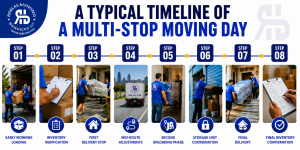
Here’s what a typical moving timeline looks like:
Conclusion
Multi-stop moves don’t have much room for error. The more locations involved, the faster a disorganized crew falls behind, and catching up on a loaded truck with a full day ahead is rarely possible. Getting it right comes down to hiring a moving company that treats the planning as seriously as the move itself.
At Roblas Moving Services, we have been operating in San Antonio since 2016, completing over 350 moves each month across San Antonio, Austin, and the wider Texas metro. Multi-stop jobs are routine for us, not an exception.
Ready to plan your multi-stop move? Call Roblas Moving Services for a straightforward quote with no hidden fees today!