

Smart Packing: What To Take With You And What To Load In The Truck
Relocation is often viewed as a singular event of transporting belongings from Point A to Point B; however, it requires a strategic segregation of assets based on necessity, fragility, and structural integrity. The most critical decision in this logistical process is determining the chain of custody: what remains in your personal possession and what is secured within the cargo hold of the moving truck.
This distinction is vital for risk mitigation. By categorizing your inventory into “personal transit” and “cargo transit,” you can guarantee the safety of high-value assets while maximizing the spatial efficiency of the moving vehicle. In this blog, we are going to build a checklist for you, so that you can efficiently organize your belongings during the move!
An Overview of What Goes Where During a MoveEffective relocation logistics depend on segregating inventory into two categories: immediate essentials and bulk cargo. Critical documentation, medication, high-value assets, and sensitive electronics should remain in your personal vehicle to ensure security and accessibility. Conversely, heavy furniture, major appliances, and boxed household goods are structurally suited for the moving truck, acting as the stabilizing foundation of the load. |
Items You Should Always Take With You
Critical Documentation
Your personal vehicle should act as a mobile safe for hard-copy records. Once documents are loaded into a truck, they are effectively inaccessible until the unpacking phase, which may be days or weeks later. Consequently, you must retain custody of identification papers (passports, birth certificates), financial instruments (checkbooks, deeds, titles), and medical records. In the event of a logistical delay or an emergency during transit, immediate access to these files is non-negotiable.
Essential Medications and Health Items
Moving trucks are not climate-controlled environments. Extreme temperatures in the cargo bay can degrade the chemical stability of certain pharmaceuticals, rendering them ineffective or unsafe. Furthermore, the risk of a truck breakdown or delivery delay means you should never pack daily prescriptions in the cargo hold. Maintain a dedicated supply of all necessary medications, first-aid supplies, and medical devices (such as CPAP machines) in your personal vehicle to ensure uninterrupted health maintenance.
High-Value Assets
Jewelry and cash are high-risk items for theft or loss when mixed with general household goods. By keeping these valuables with you, you maintain a strict chain of custody, ensuring they are never out of your sight during the chaotic transition of moving day. If you are utilizing commercial packing services in Texas for an office move, this rule applies to hard drives containing sensitive IP or company data as well.
Personal Essentials Bag
The “First Night” kit is a logistical necessity. Upon arrival at the new residence, you may not have the energy or time to locate specific boxes immediately. A dedicated bag containing toiletries, a change of clothes, device chargers, and basic bedding ensures you can function comfortably for the first 24 to 48 hours without needing to breach the main cargo load.
Items Safe to Load in the Moving Truck
Furniture & Large Household Pieces
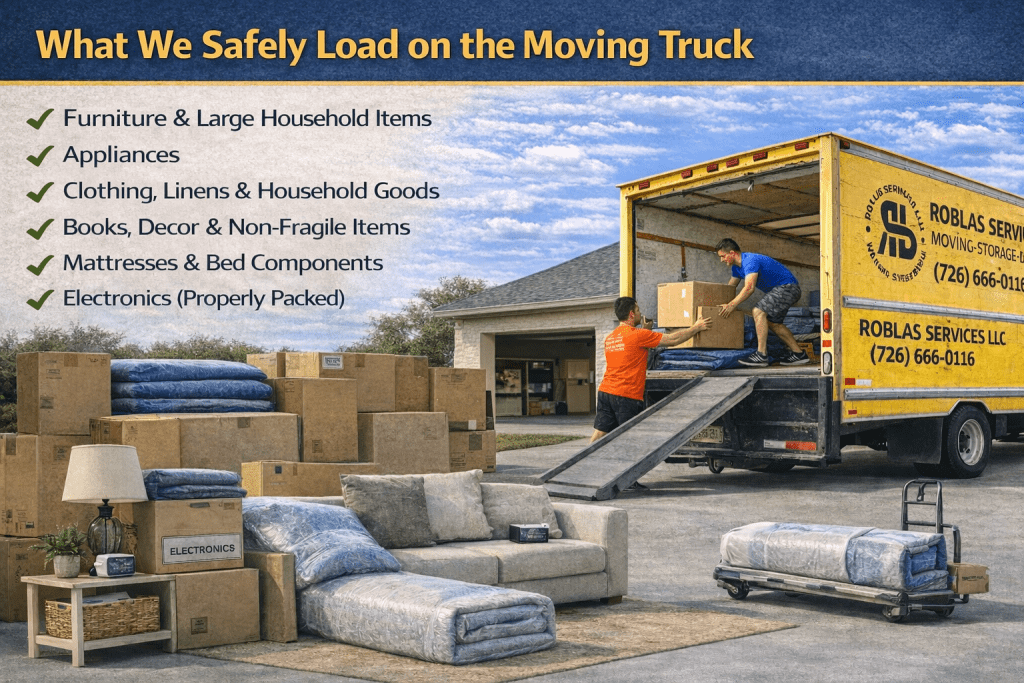
Big items like sofas, beds, dining tables, dressers, desks, and shelves are perfectly fine to load into the truck. These pieces are solid, well-built, and designed to handle pressure and movement. Once they’re wrapped in moving blankets and strapped in place, they stay arranged and actually help create a stable base inside the truck. Furniture also acts as a protective barrier, keeping smaller boxes from shifting around during the drive.
Major Appliances
Appliances such as refrigerators, washing machines, dryers, and dishwashers are safe to take as long as they’re prepped properly. These machines are heavy and sturdy, which works in their favor during transport. When they’re cleaned, drained, and secured upright, they handle road vibrations without trouble. Taping the doors shut and padding the sides keeps everything protected until unloading. If you are unsure how to prep these, many moving and packing services in San Antonio offer appliance disconnect and reconnect services.
Clothing, Linens & Everyday Household Items
Clothes, bedding, towels, and similar items are some of the easiest things to move. They’re soft, lightweight, and don’t break, which makes them ideal for truck loading. Packed neatly into boxes, they stack well and can even be used to fill small gaps between heavier items. Even if there’s some movement along the way, these items won’t be damaged.
Books, Decor & Non-Fragile Items
Books, rugs, lamps (with bulbs removed), mirrors, and decorative pieces are safe when packed correctly. Books are especially useful because they add weight where you want it, lower in the truck, helping with balance. Rugs and soft decor can be rolled or wrapped to protect nearby items, while framed pieces travel safely when padded and kept upright.
Mattresses & Bed Components
Mattresses are pressure-distributing items. They absorb force rather than resist it. When stored upright, they act as shock buffers between hard surfaces and also won’t suffer internal damage from vibration, bending, or compression during transit.
Electronics (Properly Boxed)
TV boxes and electronic cartons are engineered with foam spacing that prevents screen flex and internal circuit shock. This makes electronics transport-safe in a truck, as long as they remain upright and isolated from direct weight, which is not true for loose or unboxed electronics.
Conclusion
Dividing your belongings carefully saves time during loading and unloading, reduces last-minute stress, and makes your first stay in the new home comfortable. If you still need professional support or are searching for reliable movers near me in San Antonio, Roblas Moving Services is here to help. Our experienced team handles local and long-distance moves with careful planning, secure packing, and efficient execution, so your move stays organized from start to finish!
FAQs
What Should Not Be Packed In A Moving Truck?
Flammable or hazardous materials
Perishable food, plants
Medications
Valuables
Important documents
Firearms
Ammunition and pets
These items are unsafe, sensitive to heat or delays, or too important to risk during transit.
How Do Temperature Changes Affect Items Inside A Moving Truck?
How Is Weight Distribution Managed Inside A Moving Truck?
How Can Pre-Packing Reduce Stress On Moving Day?